Kalman
Klim Brattman Give me
the simplest form of
life,
and I will build, out
of it, the biological
world of Nature..... .
Selected
Topics
3.
Biological Awareness
(Biowareness)
Congo peafowl.
On Biological
Awareness as
Hallmark and Guardian of
Life
Once the preLife
was able to pop-out
and emerge into proLife,
in order to be able to continue with its
existence and development, it had to secure
its three (3) basic supporting pillars of Life:
food, defense,
and shelter (fodesh)
on the foundation of survex.
Biosensor
For that task, Natural
Selection (Natsel),
for its living organisms, created a
multitude of biological sensors
(biosensors) capable of picking up
from their surrounding habitat certain
distinctive characteristics such as smell,
smoke, noise, light, temperature, humidity,
and even the presence of a magnetic field.
All those biosensors,
as needed, were available to be used
by the living organisms to adapt and find
available niches for their existence growth
and development.
Six (6)
distinct biosensors
were able to emerge encompassing touch (tactile
stimuli system), vision (visual
stimuli system), hearing (auditory
stimuli system), smell (olfactory
stimuli system), taste (gustatory
stimuli system), and some type of a
magnetic field biosensor, most studied and
marveled being the pigeon magnetic(pimag)
one (acting as a magnetic compass for
the pigeon navigation). The
transmission of those stimuli is
done via specific chemical reactions of
transmission (CROTs).
As such, for Life (of its
living organisms) to continue with its
existence it had to be endowed, from its
birth, with environmental intercepts
(envints) that channeled the
direction of evolution. Adaptability
to change (adaptoc)
based on those evolutionary directions
became the windows from where species would
evolve.
We mark that fundamental
recognition of Life's
evolution in
The Eighteen Foundational
Universal Recognition Of
Nature(18thFURON): All Life of
living organisms is endowed
with underneath mobility
guided by its environmental
intercepts (envints).
• Without envints, Life is
doomed to self-extinction.
• The more envints a species
has, the more successful and
resilient is going to be.
The variety of
species in the plant and
animal kingdoms that evolved
from envints are
staggering indeed. The
mobility of Life
that emerges as its underneath
characteristic is a direct
result of those envints. Plants, like
the sunflowers, rotate their
heads to follow continuously
the movement of the Sun.
Birds, like pigeons, use
Earth's magnetic field in
determining their position and
direction in their migration.
Mobility guidances of that
nature are mind-boggling
indeed.
Fundamental
Remarks: • Life's
inherent
mobility exists
because of an
underneath relationship
that Life
can establish with
Nature. Life
cannot exist in
a vacuum. •
That underneath
relationship that
Life
can establish with
Nature is done
through an
underneath
existential
passage called the
Underneath
Bridge of
Communication
(UBOC).
Life
abhors a vacuum.
For
each stimulus, a memory ergo pallet
(MEP) was created to be retrieved and
used when needed. As such, some sort of a memory
based "intelligence" (memotelligence)
was needed to be born. The
arrival of that strange intelligence (called
also xeno intelligence
or xenotelligence) in the Kingdom
of Life (KOL) is truly monumental and
is being recognized in here through
The Nineteen Foundational
Universal Recognition Of
Nature(19thFURON): All Life of
living organisms is endowed
with some form of Memotelligence.
Without memotelligence, Life is
doomed to self-extinction.
Under the pressure of Natural Selection (natsel),
the memotelligence,
as a tool of survival, become increasingly
in demand as a centerpiece survival tool.
And that is because those retained MEPs
would be able to shape the evolutionary
direction of further development for that
living. Without those MEPs
that stored past events, a
plant (or other primal livings) would be far
less equiped for survival and, by sofit,
it will have to perish. We mark that
important survival recognition into:
The
First Evolutionary Principle
Of Survival (1st EPOS): Memotelligence
Only livings
that are best equiped with a memory
intelligence (memotelligence) will be able
to survive the challenges of
its environment provided that
the respective environment can
continue to harbor life.
While the 1st EPOS
is a necessary condition for a living to
survive, that however is not a sufficient
condition. And that is because the memotelligence
of that living must incorporate, in
addition, a sufficient large number of
diverse MEPs
capable to allow the living's memotelligence a
range of diverse capabilities needed for
adapting to new encountered environmental or
bodily changes. Charles
Darwin fully
recognized that livings that can adapt best
to change are the ones that, in the end,
will continue to survive,in the context of sofit.
We mark that pivotal recognition pioneered
by Darwin
into:
The
Second Evolutionary Principle
Of Survival (2nd EPOS): Larger
Diversity of MEPs
Only livings
that have a larger number of
diverse memory ergo
pallets (MEPs) can adapt
best to change and, as such,
able to survive provided that
the respective environment can
continue to harbor life.
Memotelligence, as
such, will create the ability of livings to
recognize and react to its surroundings and to
its bodily changes through a new developing
trait, the biological awareness
(biowareness) trait. That new trait, in
turn, will set up for the formation of a
biological brain, called biobrain,that becomes now the guardian of Life
for all successful livings.
That allLife
of living organisms is endowed with a memory
based "intelligence" necessary for its
survival is flabbergasting indeed. As a
result of that memotelligence,
Life of living organisms was
able to be endowed with the adaptability
to change (adaptoc)
vital characteristic.
That adaptoc
charactheristic is responsible, as such, for
the biological evolution (biolev)
of Life in the living
organisms. We mark that staggering adaptoc
recognition, first posted by Charles
Darwininto
The Twentieth Foundational
Universal Recognition Of
Nature(20thFURON): The motor
of Life's biological
evolution is its adaptability
to change (adaptoc).
Without adaptoc, Life is
doom to precarious
stagnation leading to its
self-extinction.
As such, adaptoc
that was created through Darwin's survival
of the fittest (sofit), will provide
the direction of evolution of Life
for the living organisms to continue with
their existence. And the direction of Life's
evolution is continuously chiseled and
guided by its evolving memotelligence.
>
=
<
The direction of evolution of sofit
culminated in xenotelligence
with the addition, to its memory based
characteristic, of a new intertwined logic
based characteristic (logichar)
able now to add a new dimension in securing
fodesh.
New features, such as Planning
Characteristic (planchar) and
Tool Creations (toolets), were
able now to emerge out of logichar.
That created survival kit (survikit)
of Life's
evolution added a fundamental new
life-saving feature that is being now
recognized in
The Twenty-First Foundational
Universal Recognition Of
Nature(21thFURON):
The
arrival of
Logic into the
arsenal of
xenotelligence
added to Life
of the living
organisms its
new
groundbreaking
Survival
Kit (Survikit)
package.
In
theanimal
kingdom (anidom),
stunning protective responses were able to
evolve due to the continuous and relentless
"chiseling" of natsel.
The mimicry or the camouflage
that have evolved are stunning examples of
those adaptive responses driven by the
Natural Selection applied to the defense
component of fodesh.
The origin and the
development of mimicry
and camouflage
can be explained with ease from Natural
Selection (natsel),
as outlined in
The
Grand Theorem Of Biological
Evolution:
The Mimicry and Camouflage
as sublime byproducts of
Natural Selection.
Proofs:
The poisonous
animals, to scare and advertise
with their poison, were vested
in very bright colors. Animals
that were not poisenous that
resembled the colors of the
poisonous one were able to
survive better than the one that
did not resemble the poisonous
ones. As natsel began selecting
the ones resembling most the
poisonous one, the mimicry
was born. A color
evolutionary transmutation (colevot)
began by natsel of continuously
perfecting the look of the
mimics to approximate best the
look of the poisonous animal.
With that, the animal mimicry
was born.
On a different
track, animals whose colors
blended best with their
environment were able to evade
the most their predators and,
as such, they were selected by
natsel. Again a color
evolutionary
transmutation (colevot) began
by natsel of
continuously perfecting the
look of the animals to blend
best with their environment.
The protective coloration, i.e.,
the animal camouflage
was born.
QED.
On Biological
Hierarchical Evolutionary Cycles (BIOHECs)
In the biological world
(BioWorld), two (2) distinct evolutionary
platforms (evoPLATs) can be found to
exist: --the base
individual platform (bindiPLAT)and --the
elevated group platform (elegroPLAT).
Both those evolutionary hierarchical
platforms (HIPLATs),
the BINDI and the ELEGRO
platforms, must (by the 2nd FUSON)
have one and the same foundational
evolutionary objective of existence
(obex) --that of being able to stay
stronger and expand faster and further of
their arena of existence (arex) than
the rest.
That is to say that obex,
on both platforms,
must be driven by the same foundational
evolutionary engine that Darwin's principle
of Natural Selection (natsel)
provides through its "survival
of the fittest" (sofit)
structural filter.
At the base
individual
platform --the bindiPLAT,
theobexis vested in the natural process of
selecting the individual that is able to
adapt best to environmental changes, i.e.,
the one with the best adaptoc.
Biological
Altruism (BioALT)
At
the elevated group
platform --the elegroPLAT,
the obex
must also be vested in selecting the fittest
survivable groups within a species, i.e.,
selecting the groups with best adaptocs.
That selection now is not between
individuals,
but is between groups. The process of that
group selection must now be examined anew
because the ELEGRO
group platform is distinct from the one of BINDI.
Darwin, in his 1871 "The
Descent of Man" book, discussed the
origin of the altruistic and
self-sacrificial behaviour of humans. There,
he recognized (pp. 163-168 ibidem)
that the self-sacrificial behaviour of a
member, although disadvantageous for the
member that could perish in the "line of
duty," might be beneficial for the group, as
a whole, because the group has acquired an
added level of alert and/or protection that
will generate a higher adaptocgrade. As such,
at the group level, Darwin recognized, that
sofit
will select those groups that are endowed
with the best protective mechanisms. And
that is indeed a monumental recognition that
at the expense
of some members that could
perish (by sacrificing
themselves for the common good
of the group), the group that
has evolved into having
self-sacrificing members as
sentinels, alerting and/or
defending the incoming
predators, will have the upper
hand of adapting in surviving
when compared with the groups
that lack such protective
altruistic "soldiers."
From those considerations,
the Biological Altruism (BioALT)was born as being the sofit's
group mechanism of natural selection towards
achieving its obex.
The recognition that sofit,
at the ELEGRO
group level, will lead to the creation and
evolution of altruism is indeed most
remarkable. In addition, the fact that sofit
manifests its existence markedly different
in the two biological hierarchical
platforms (HIPLATs)
governing Nature, the bindiPLAT
and the elegroPLAT,
reveals of the complexity and the
intricacies of biological
evolution (biolev).
On the Ultimate
Biological Necessity of Life (Ubinol): Biological Communication
(Biocom)
All forms of Life
have evolved with one common necessity, that
of communication both internally and
externally for being able to best adapt
to change(adaptoc).
• The internal
communication is between cells needed
for the body's self-defense towards
microbial and viral intruders.
That form of
comunication is a chemical
communication done via CROTs.
• The external
comunication is for territorial
defense, attracting mates, establish
dominance, coordination and planning for
defense or offense, etc.
While in the animal
kingdom (anidom)
that animal communication (anicom)
is most visible and was known to exist from
immemorial times, in the plant
kingdom (plantdom) that plant
communication (plantcom) is much less
visible and was recognized to exist only
from a few decades ago.
On the Plant
Communication
(plantcom)
Plant groups,
in order to best adapt to
change (adaptoc)
in their respective environments, had by natural
selection (natsel),
to develop a system of communication
(systco) capable of contacting other
nearby plants forming local community
plant (coplant) networks. Those coplants,
that are ELEGRO
groups, because of having a systco,
were better equiped for
their survival than the plant groups that do
not have.
And
that is because through such a systco,
the members of a coplant
were able, if needed, to receive:
• water and
nutrients from the nearby
companions, • distressing signals
allowing them to alter their
behavior into a defensive
posture against invading
predators.
Thus, in a coplant,
we have emitters and receivers.
While the benefits
of the receivers are obvious, the ones of
the emitters are not. Thus, the question
that needs to receive an answer is this: WHY Natural Selection selected such an
evolutionary path?
Well,
the answer to this is that the altruistic
characteristic that exists in the animal
kingdom (anidom)
exists also in the plant
kingdom (plantdom)
as detailed below.
On the Plant Altruism
(Plantalt)
Natural
selection (natsel) at the group
level, as recognized by Darwin,
will always select the groups
that have altruistic
emitters capable to
enhance the survivability of
the group, as a whole. Thus, coplants with emitters
will always be selected over
the ones that ones that do not
have such altruistic members.
In
addition of having altruistic emitters,
some coplants
could engage in chemical warfare to claim
territory and force other plants (like
weeds) off their land.
Two of the main venues
available to coplantsfor accomplishing their
functions are:
• one, with
releasing volatile organic
compounds (VOCs) into the air,
and • the other, with
secreting special chemicals
into the soil.
With the recognition that altruism
occurs not only in the animal kingdom (anidom),
but also in the plant kingdom (plantdom),
we add now this:
The Twenty-Second Foundational
Universal Recognition Of
Nature(22thFURON):
All evolved Life in living
organisms is
endowed with
an altruistic
charactheristic
that is
propelled by
Natural Selection.
.
.
.
.
On
the Animal
Communication
(anicom)
In the animal
kingdom (anidom), the animal
comunication (anicom) is done via
a complex system of
communication (systco) that
includes a number of modes:
Oy
Vey: Catherine (Cat)
Hobaiter, University of St
Andrews
Photo:
Dave Shaffer, bear wildlife
photographer.
• via visualization
incorporating gestures,
facial expression,
gaze-following, color change
and bioluminescence;
• via vocalization
vested in animal languages
and culminating with to the
human language;
• via sense
of smell or olfaction
being the oldest method of
communication via a
chemical, less understood,
form of communication;
• via specialization
vested in electric
(electro-communication) and
touch communications;
• via vibratory
seismic mode where
self-generated vibrational
signals are being
transmitted through the
soil, water, or other
platforms; and finally,
• via thermal
(or thermo-reception)
mode perceiving temperature
differences from a heat or
thermal flux.
.
Photo by
Alfonso Duran: The Peafowl
with the chicks on the move...
On Animal
Consciousness, As
a Byproduct
of Evolution
Asides from creating the biological
sensors (biosensors),
Darwin's Natsel,
began working simultaneously on a placement
self-awareness ranking platform, called the
hierarchical ranking pick (hirap) platform,
designed to enhance the stability of animal
groups within a species by eliminating the
unnecessary infightings between its members.
Since the limited resources of a habitat and
mating opportunities were the principal
sources of infightings, an emerged dominant
higher-ranking individual, called an alpha,
was designed to put at bay its
subordinate-ranking individuals stoping, as
such, those infightings.
That
self-awareness development,
of establishing the ranking placement of a
member in a group, is the marking point
(markpoint) of animal
consciousness (anicon) referred also
as the animal awareness (aniwareness).
From that markpoint,
the animal consciousness
(anicon) was able
now to take off big time...
The animal
ware (aniware)
characteristic is also the markpoint where the animal
intelligence (anitelligence)
begins to emerge into the
formation of the animal brain
(anibrain). Again, from
that markpoint, the animal brain
(anibrain) was able now to
take off big time...
The picture
above (enlarged here) with the cat
and the dog taking a nap
together is one of the stunning
example of evolutionary
animal consciousness (evanco).
On Plant
Consciousness, As
a Byproduct
of Evolution
.The
consciousness is not exclusive to the
the animal kingdom (anidom)
as it exist, in a different form, in the plant
kingdom (plantdom),
called plantciousness, as detailed
below.
We
start with the recognition that plants have
acquired,
through natural
selection (natsel),
an environmental awareness, called plantwareness
or simply plantware, that allows
them to sense and react (senar) to
various environmental conditions such as
light, gravity, touch, smell, or vibration.
• A
visible, most common, example of
sunlight-senar
is the Sunflower.
• All
plants evolved to aquire the
touch-senar
and the gravity-senar
as plants are able to sense the
touch and the gravity (called gravitropism).
The
gravitropism clearly can
visible be seen in
the plant's
directional
movements and
development. Indeed,
in roots, gravity is
sensed by making
them to elongate in
the direction of
gravity. In shoots,
growth occurs in the
opposite direction,
a phenomenon known
as the negative
gravitropism.
The
touch-senar
clearly can visible
be seen in the
so-called "sensitive
plant" (Mimosa
pudica)
that responds
quickly to even the
slightest physical
touch by folding its
thin pinnate leaves
pointing downwards.
And in the carnivorous
plants, such
as the Venus
flytrap (Dionæa
muscipula),
its specialized leaf
snap shut when
touched or landed
upon by insects.
• The
smell-senar
of plants can
visible be seen in the insect
infected plants that produce
distinctive volatile odors, that
in turn, can be perceived by
neighbouring plants that can
trigger a number of CROT
defenses.
• The
vibratoty-senar
of plants, in response to
vibrations created during
herbivory, is done with the
release of certain CROTs
(such as glucosinolate and
anthocyanin).
As in the case
of animal awareness (aniwareness), the plant
awareness (plantwareness) will generate
a memory-based distinctive plant
intelligence (plantelligence).
Plants, for
sure, do not have brains nor
neuronal structures like animals
do, but they have CROTbiochemical
pathways that are able to
generate memory
ergo pallets (MEPs) leading to the
formation of the memory-based plantelligence as recognized
in the 19th FURON.
Now,
the plant consciousness (plantciousness)
existence is a foregoing conclussion that is
being expressed through sophisticated CROT
interactions with their soil and, with their
shared siblings and foes (SAF) that
they recognize to exist.
However, aside
from that sibling
and foes (SAF)
recognition, the ultimate visible expression
of that plantciousness
is the plant's distress signal (PDS).
Yes, upon attack, plants emit distress
signals, called distressnals.
BTW: The aroma of
freshness that we smell after
lawn mowing the grass, is in
fact the grass' PDS after its harsh
and painful haircut! Grass
and other leafy plants routinely
emit a variety of vaporous
distress signals called green
leaf volatiles (GLVs).
That plants
actually feel pain and relate
that pain through PDS is
mind-boggling as that felling of pain (FOP) is central in
recognizing the existence of plant's
consciousness.
With that last mind-boggling inference, we
are ready now to enunciate this transcending
biological recognition of Life
in living organisms vested in
The Twenty-Third Foundational
Universal Recognition Of
Nature(23rdFURON): All
Life in living organisms is
endowed and exhibits some
form of Consciousness.
where consciousness
is defined as the awakenstate of double awareness
(asoda): ofthe living's own existence
(aka, internal existence)
and of
the environmental surrounding
existence (aka, external
existence).
Without consciousness, Life
of a living is doomed to
extreme fragility leading to
its self-extinction.
To recap,
we have recognized that all Life of living
organisms is endowed with
(i)
some form of memory-based
inteligence (memotelligence),
(ii)
with some form of logic-based
characteristic (logichar),
(iii)
with some sort of altruistic
charactheristic, and
(iv)
with some form of consciousness.
Those four (4)
foundational underlying
characteristics of Life in all
livings are the pillars of
the Foundational
Evolutionary Platform Of
Life (FEPOL).
The consciousness
and communication
that stand as the pillars of Life
in all livings have an underlying biological
common denominator (BICODE) vested in
their underlying CROTs
as recognized in
The
Twenty-Fourth Foundational
Universal Recognition Of
Nature(24thFURON): All
Life of the livings
transmits its Consciousness and Communications via an
underlying substratum made
of CROTs.
Chemicalreactions
of transmission (CROTs), that are
at the substratum of all
Life, would create
individual genetic
signals (genesigs) whose
characteristics would be
related to the modality of
their releases.
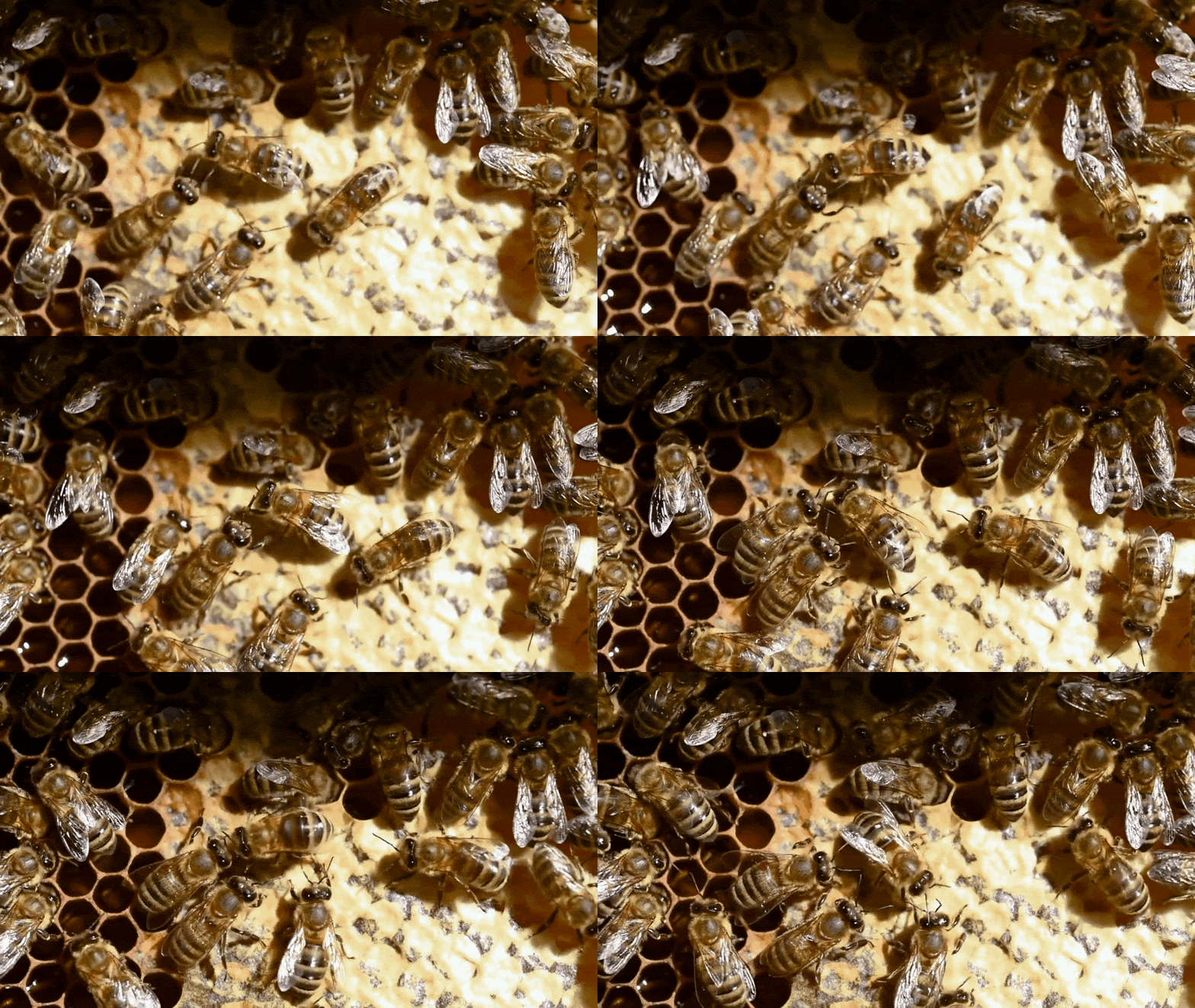
The
dazzling examples produced
by a worker honeybee with
its spectacular and
mind-boggling waggle
dance or the aromatic
distress call of the grass
that is being cut, are
stunning diverse examples of
their commonality through
which the genesigs evolved
from natural selection (natsel)
mechanisms.
•Remark: Using the
mathematical lingo, we say
that Life's underlying BICODEis modulogenesig.
On the Hardship
Benefit (HARBEN) Principle
of Plant and Animal
Biology
By 1st TOFEC,
moderate sustained hardship
should be beneficial for plants. As such,
proper lawn mowing, viewed as moderate
hardship, should be beneficial to the grass. How Come?,
i.e., Why is that beneficial to the
grass and, in which way that hardship
benefit (HARBEN) manifests its existence?
Notwithstanding the grass' distress
signal (PDS),
the proper lawn mowing is beneficial on two
fronts:
• one, that the
released GLVscontains some
natural antibiotics helping
the roots to get stronger, and
• the other
one, that mowing helps grass
grow thicker because by
suppressing the horizontal
growth, it forces the grass to
spread and grow thicker near
the roots.
The moderate sustained hardship in the
animal kingdom (anidom),
will generate to those recipients additional
MEPswhich in turn, by the 2nd EPOS,
will be most beneficial. For the evolved
human species, see the analysis below.
On the
Ecopressure Influence at the
Current Evolved Human
Species
Now, as a curiosity and interest, we
want to turn our attention to the individual
influence of the ecopressure
towards the current evolved human species.
When, if at all, that ecopressinfluence is most beneficial
--that is what we are interested the most in
finding out. All
biotic and abiotic life, at its emergence,
experience an inherent environmental
pressure (enviropress) that evolves
into an ecological
pressure (ecopress)
as life begins to develop.
The developmental stage of life is crucial
in the final outcome of an individual, as
follows:
If the individual had
experienced no any additional ecopress, then such an
individual will end up in
mediocrity, at best. Overprotection
is the main culprit. In short, overprotection
is damming for the future of
that individual as recognized in
the Detrimental
Characteristic of the 2nd TOFEC.
If, on the other hand, the said
individual experiences at the
beginning of his/her adolescence
(around age 10) a moderate
strangulation (such as the death
of a parent, of a sibling, or a
divorce of his/her parents, or
still of abusing parents, or
severe financial household
distress), then such a moderate
strangulation will be most
beneficial for the future of
that individual.
Timing, when the said moderate
strangulation should commence,
is of essence. If is too early
or too late, in the life of the
individual, then that will
annihilate completely the
beneficial effect. The earliest
time when the biowarenessfactorbecomes the
dominating factor is essential
for the beneficial outcome.
There is absolutely no exception
whatsoever from this rule. Without
such moderate strangulation, the
individual will grow into
obliviousness, as there is
nothing in the developmental
stage to stimulate awareness
and, as such, to break the
normalcy.
Without
elevated awareness
in the infantile
period, the
developmental stage
become much murky
and unsettled. And
finally, In
the case that the
strangulation is not
moderate, but sever,
then that is the
worst possible
scenario, being in
most case lethal or
being very dangerous
and a failure on so
many levels.
.
Nelson
Mandela
From the above evolutionary biology
(evoBIO) recognition that without
hardship in the developmental stage of life,
the outcome, at best, is bleak, we are ready
now to formulate
The
Cruelty Of Life Paradox (COLP)
In
order to get ahead in life, in
the developmental years,
one needs to
be exposed to a relative
strong, but not excessive,
prolonged sustained hardship,
called herein infused
"strangulation" (infugulation).
Without such a sustained infugulation
exposure, the individual, at
best, will end up in the
sub-mediocrity slot, and
at worst, in the disaster one.
Overprotection is the main
culprit.
WARNING:
IS
DAMMING...
.
Corollary to COLP: On the
Achievers
Those who have
became out-of-the-ordinary
achievers (or those who will
become in the future), were
not that "in spite of" the received
strangulation (aka the
received hardship) they
reached the stardom, but they
become extraordinary achievers
"because of" it.
Offspring from
overprotecting parents will
never become
out-of-the-ordinary
achievers, at best, they
only will reach the
mediocrity.
QED.
Observation:
One massive prevalent case
of underachievers are to be
found in today's Communist
China. And that is because of
the extremeparental
overprotection (epo) over
there, that is almost universal. It is not an
accident, that out of a
population of over 1.4 billion, there is not
one single Nobel Prize laureate
in Science coming from Red
China. In addition, asides from epo, a significant
contributing factor for that
lack of Chinese science
achievers is because of the
singular evolutionary distortedlogic functionality that
was ingrained into the Han-Chinese
Mind as posted herein.
.
Finally, we end up this page
with a rather fundamental question:
Does
Life has a Purpose (acquired
or infused) and, if so, What
that Purpose Is?
Well, most
certainty Life, by
being formed accidentally from
complex chemical reactions, was not being
infused with a purpose by anything,
as God herein is not part of
Nature's creation. Thus, if Life
has a purpose, then that purpose has to be
an acquired one.
A primal tenet of
creation was recognized to be its preservation
tendency of existence added with a resistance
to change, articulated in PT-UMOC
and RL-UMOC,
respectively. Thus, Life's
purpose is its survivability that
can be achieved only through a sustained evolutionarylineage (evolin). We mark that
ultimate evolutionary recognition into
The Twenty-Fifth Foundational
Universal Recognition Of
Nature(25thFURON):
All
Life of living
organisms is
endowed with
an ultimate
purpose that
is of its
continued
survival
achieved
through a
sustained
evolutionary
lineage.
And before we leave,
If
God
is not in the picture and Life
appeared to pop-up in an accidental
manner, the question that begs for an answer
is
from
where Life got its
guidance, pursuing its
evolutionary development?
Well, the simple answer is that no guidance
of any sort is there. But, if that is so,
that no agent is there to exist in guiding
the development of Life, then
the question that now needs to be answered
is
how
Life has been able to
find its evolutionary path?
The answer again is quite
simple: through accidentalrandom
mutations (randomuts) that were able
to pop-up accidentally acquiring the
best adaptoc.
Thus, the engine of Life's
development is being fueled by the accidental
pop-up randomuts.
We mark this ultimate
underlying recognition of Nature into
The Twenty-Sixth Foundational
Universal Recognition Of
Nature(26thFURON):
The
ultimate
engine of
biological
evolution is
fueled by the
accidental pop-up
randomuts able
to have the
best
capability of
surviving and
adapting to change (adaptoc).
Remarks:
1.That
is to say, that Nature's
architects are the randomuts. And 2. There will be
situations where none of the
created randomuts of a species
will be able to create or
find, for their continued
existence, a passage of
survival (pos). In those
failing situations, such a
species will perish becoming
extinct. Thus, we can talk
of the existence of
evolutionary background normalextinctions (normexes)
phenomena that need to be
differentiated from the abnormalmass
extinctions (massexes).
Biology cannot
breathe without Evolution as Religion cannot
breathe without God...







 Congo peafowl.




 Six (6)
distinct biosensors
were able to emerge encompassing touch (tactile
stimuli system), vision (visual
stimuli system),
Six (6)
distinct biosensors
were able to emerge encompassing touch (tactile
stimuli system), vision (visual
stimuli system),  hearing (auditory
stimuli system), smell (olfactory
stimuli system), taste (gustatory
stimuli system), and some type of a
magnetic field biosensor, most studied and
marveled being the pigeon magnetic (pimag)
one (acting as a magnetic compass for
the pigeon navigation). The
transmission of those stimuli is
done via specific chemical reactions of
transmission (CROTs).
hearing (auditory
stimuli system), smell (olfactory
stimuli system), taste (gustatory
stimuli system), and some type of a
magnetic field biosensor, most studied and
marveled being the pigeon magnetic (pimag)
one (acting as a magnetic compass for
the pigeon navigation). The
transmission of those stimuli is
done via specific chemical reactions of
transmission (CROTs).


 The variety of
species in the plant and
animal kingdoms that evolved
from envints are
staggering indeed. The
mobility of Life
that emerges as its underneath
characteristic is a direct
result of those envints. Plants, like
the sunflowers, rotate their
heads to follow continuously
the movement of the Sun.
Birds, like pigeons, use
Earth's magnetic field in
determining their position and
direction in their migration.
Mobility guidances of that
nature are mind-boggling
indeed.
The variety of
species in the plant and
animal kingdoms that evolved
from envints are
staggering indeed. The
mobility of Life
that emerges as its underneath
characteristic is a direct
result of those envints. Plants, like
the sunflowers, rotate their
heads to follow continuously
the movement of the Sun.
Birds, like pigeons, use
Earth's magnetic field in
determining their position and
direction in their migration.
Mobility guidances of that
nature are mind-boggling
indeed.

 • Life's
inherent
mobility exists
because of an
underneath relationship
that Life
can establish with
Nature. Life
cannot exist in
a vacuum.
• Life's
inherent
mobility exists
because of an
underneath relationship
that Life
can establish with
Nature. Life
cannot exist in
a vacuum.


 For
each stimulus, a memory ergo pallet
(MEP) was created to be retrieved and
used when needed. As such, some sort of a memory
based "intelligence" (memotelligence)
was needed to be born.
For
each stimulus, a memory ergo pallet
(MEP) was created to be retrieved and
used when needed. As such, some sort of a memory
based "intelligence" (memotelligence)
was needed to be born. The
arrival of that strange intelligence (called
also
The
arrival of that strange intelligence (called
also 





 That all Life
of living organisms is endowed with a memory
based "intelligence" necessary for its
survival is flabbergasting indeed. As a
result of that
That all Life
of living organisms is endowed with a memory
based "intelligence" necessary for its
survival is flabbergasting indeed. As a
result of that  As such,


 The origin and the
development of mimicry
and camouflage
can be explained with ease from Natural
Selection (
The origin and the
development of mimicry
and camouflage
can be explained with ease from Natural
Selection ( Proofs:
 The poisonous
animals, to scare and advertise
with their poison, were vested
in very bright colors. Animals
that were not poisenous that
resembled the colors of the
poisonous one were able to
survive better than the one that
did not resemble the poisonous
ones. As
The poisonous
animals, to scare and advertise
with their poison, were vested
in very bright colors. Animals
that were not poisenous that
resembled the colors of the
poisonous one were able to
survive better than the one that
did not resemble the poisonous
ones. As 


 In the biological world
(BioWorld), two (2) distinct evolutionary
platforms (evoPLATs) can be found to
exist:
In the biological world
(BioWorld), two (2) distinct evolutionary
platforms (evoPLATs) can be found to
exist: --the base
individual platform (bindiPLAT) and
--the base
individual platform (bindiPLAT) and --the
elevated group platform (elegroPLAT).
--the
elevated group platform (elegroPLAT).
 Both those evolutionary hierarchical
platforms (
Both those evolutionary hierarchical
platforms (
 As such,
at the group level, Darwin recognized, that
As such,
at the group level, Darwin recognized, that
 From those considerations,
the Biological Altruism (
From those considerations,
the Biological Altruism (




 in the plant
kingdom (plantdom) that plant
communication (plantcom) is much less
visible and was recognized to exist only
from a few decades ago.
in the plant
kingdom (plantdom) that plant
communication (plantcom) is much less
visible and was recognized to exist only
from a few decades ago.


 Well,
the answer to this is that the altruistic
characteristic that exists in the animal
kingdom (anidom)
exists also in the plant
kingdom (plantdom)
as detailed below.
Well,
the answer to this is that the altruistic
characteristic that exists in the animal
kingdom (anidom)
exists also in the plant
kingdom (plantdom)
as detailed below.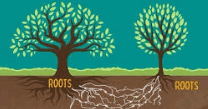


 In
addition of having altruistic emitters,
some
In
addition of having altruistic emitters,
some 

 .
.




 Photo by
Alfonso Duran: The Peafowl
with the chicks on the move...
Photo by
Alfonso Duran: The Peafowl
with the chicks on the move...


 Asides from creating the biological
sensors (
Asides from creating the biological
sensors (


 That
self-awareness development,
of establishing the ranking placement of a
member in a group, is the marking point
(markpoint) of animal
consciousness (anicon) referred also
as the animal awareness (aniwareness).
From that markpoint,
the animal consciousness
(anicon) was able
now to take off big time...
That
self-awareness development,
of establishing the ranking placement of a
member in a group, is the marking point
(markpoint) of animal
consciousness (anicon) referred also
as the animal awareness (aniwareness).
From that markpoint,
the animal consciousness
(anicon) was able
now to take off big time...




 .The
consciousness is not exclusive to the
the animal kingdom (anidom)
as it exist, in a different form, in the plant
kingdom (plantdom),
called plantciousness, as detailed
below.
.The
consciousness is not exclusive to the
the animal kingdom (anidom)
as it exist, in a different form, in the plant
kingdom (plantdom),
called plantciousness, as detailed
below. 

 We
start with the recognition that plants have
acquired,
through natural
selection (
We
start with the recognition that plants have
acquired,
through natural
selection ( The
smell-senar
of plants can
visible be seen in the insect
infected plants that produce
distinctive volatile odors, that
in turn, can be perceived by
neighbouring plants that can
trigger a number of
The
smell-senar
of plants can
visible be seen in the insect
infected plants that produce
distinctive volatile odors, that
in turn, can be perceived by
neighbouring plants that can
trigger a number of 


 Now,
the plant consciousness (
Now,
the plant consciousness ( Grass
and other leafy plants routinely
emit a variety of vaporous
distress signals called green
leaf volatiles (GLVs).
Grass
and other leafy plants routinely
emit a variety of vaporous
distress signals called green
leaf volatiles (GLVs).




 To recap,
we have recognized that all Life of living
organisms is endowed with
To recap,
we have recognized that all Life of living
organisms is endowed with  The
The 


 All
biotic and abiotic life, at its emergence,
experience an inherent environmental
pressure (enviropress) that evolves
into an ecological
pressure (
All
biotic and abiotic life, at its emergence,
experience an inherent environmental
pressure (enviropress) that evolves
into an ecological
pressure (
 In short, overprotection
is damming for the future of
that individual as recognized in
the Detrimental
Characteristic of the
In short, overprotection
is damming for the future of
that individual as recognized in
the Detrimental
Characteristic of the  Timing, when the said moderate
strangulation should commence,
is of essence. If is too early
or too late, in the life of the
individual, then that will
annihilate completely the
beneficial effect. The earliest
time when the
Timing, when the said moderate
strangulation should commence,
is of essence. If is too early
or too late, in the life of the
individual, then that will
annihilate completely the
beneficial effect. The earliest
time when the  Without
such moderate strangulation, the
individual will grow into
obliviousness, as there is
nothing in the developmental
stage to stimulate awareness
and, as such, to break the
normalcy.
Without
such moderate strangulation, the
individual will grow into
obliviousness, as there is
nothing in the developmental
stage to stimulate awareness
and, as such, to break the
normalcy. In
the case that the
strangulation is not
moderate, but sever,
then that is the
worst possible
scenario, being in
most case lethal or
being very dangerous
and a failure on so
many levels.
In
the case that the
strangulation is not
moderate, but sever,
then that is the
worst possible
scenario, being in
most case lethal or
being very dangerous
and a failure on so
many levels.
 From the above evolutionary biology
(evoBIO) recognition that without
hardship in the developmental stage of life,
the outcome, at best, is bleak, we are ready
now to formulate
From the above evolutionary biology
(evoBIO) recognition that without
hardship in the developmental stage of life,
the outcome, at best, is bleak, we are ready
now to formulate





 Those who have
became out-of-the-ordinary
achievers (or those who will
become in the future), were
not that "in spite of" the received
strangulation (aka the
received hardship) they
reached the stardom, but they
become extraordinary achievers
"because of" it.
Those who have
became out-of-the-ordinary
achievers (or those who will
become in the future), were
not that "in spite of" the received
strangulation (aka the
received hardship) they
reached the stardom, but they
become extraordinary achievers
"because of" it.
 Offspring from
overprotecting parents will
never become
out-of-the-ordinary
achievers, at best, they
only will reach the
mediocrity.
Offspring from
overprotecting parents will
never become
out-of-the-ordinary
achievers, at best, they
only will reach the
mediocrity.
 Observation:
One massive prevalent case
of underachievers are to be
found in today's Communist
China. And that is because of
the extreme parental
overprotection (epo) over
there, that is almost universal.
Observation:
One massive prevalent case
of underachievers are to be
found in today's Communist
China. And that is because of
the extreme parental
overprotection (epo) over
there, that is almost universal.
 A primal tenet of
creation was recognized to be its preservation
tendency of existence added with a resistance
to change, articulated in
A primal tenet of
creation was recognized to be its preservation
tendency of existence added with a resistance
to change, articulated in 




 If
If
 The answer again is quite
simple: through accidental random
mutations (randomuts) that were able
to pop-up accidentally acquiring the
best
The answer again is quite
simple: through accidental random
mutations (randomuts) that were able
to pop-up accidentally acquiring the
best